threelilprincesses.com

Tag: The Wonder Weeks

  • The Wonder Week: Wake me when it’s over

    The Wonder Week: Wake me when it’s over


    baby with hat on
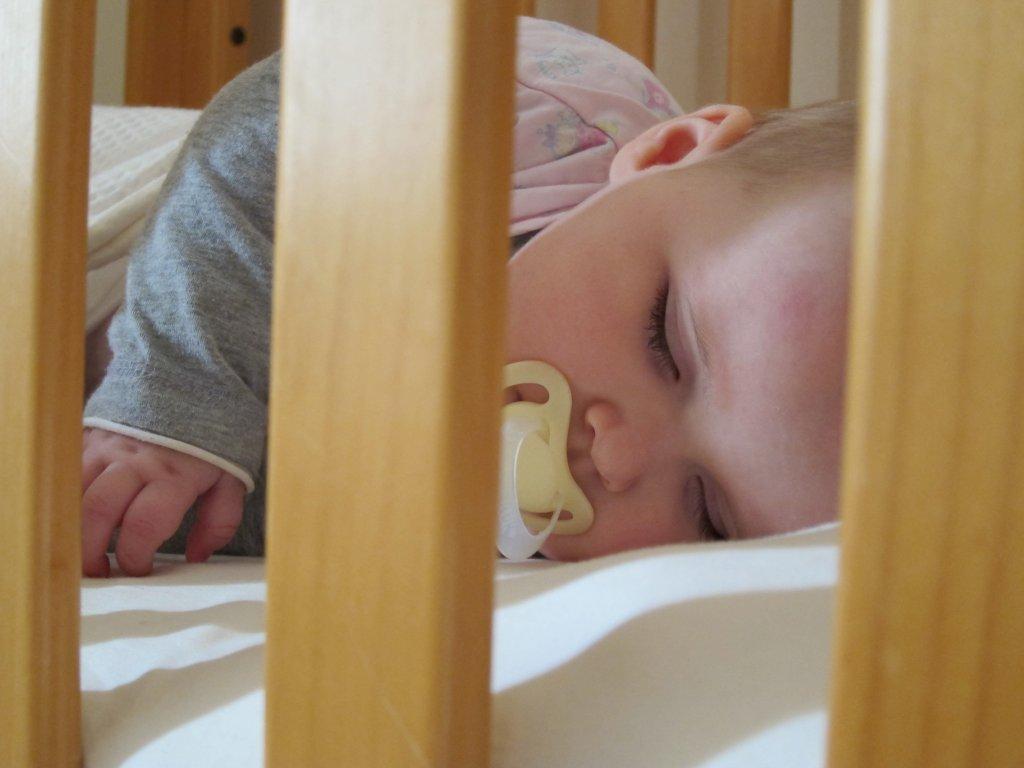
    Baby Holly during a sunny period.

    WITH so much interest in The Wonder Weeks, I thought I’d continue posting as Baby Holly passes through each fussy period. Besides, it’s so easy to write about a Wonder Week when you’re in the midst of a sunny period. Yes, I’m SUPER thankful for that.

    To be frank, the last Wonder Week – Wonder Week 46 – was, well … let’s just say I gained a further three grey hairs. So forgive me if I didn’t feel like posting about it at the time. You may well have seen quite a bit of colourful language going on if I had. Just call me Joan Rivers, minus the facelift.

    The three Cs – cranky, clingy and crying – were out in force. We went through some major separation anxiety, which didn’t help her start to childcare. Try leaving the room when she’s stapled to your leg. Things have settled down now.  Again, thankful for that.

    Week 46 is all about The World of Sequences. It’s about how things fit and belong together. For example, they know the spoon has to go in the bowl and then into their mouth. Instead, it tends to catapult from the spoon to the wall for a new Weetbix wallpaper finish.

    The seventh developmental stage is called The World of Sequences. And no, that’s not the stuff you put around the ruffles on your fuschia-coloured skirt. Following it, Baby Holly is now:

    • Pointing at what she wants and is babbling more than ever. More words are emerging, including “sister’’ and “Mum’’ (yay!).
    • Is able to take the spoon from my hand and place it in her mouth. She has been able to feed herself finger food for some time now.
    • Fills bath containers with water and then pours them out. Or throws them at her sister, which ends in tears – always.
    • Learning to stack her ring stacker and can see her processing how to stack blocks.
    • Becoming more game when walking from one piece of furniture to the next and letting go more often as she begins to learn to stand unassisted.
    • When giving her a horsey ride on my foot, she bends her knees, aiming to jump higher off the floor.
    • Tries to climb steps – and everything else. Heaven help us!
    • Participates more in peek-a-boo and gets excited when playing hide-and-seek with her sister.
    • Imitates a lot of what I do, including brushing her teeth and hair. If only she had some hair.
    • Blows hot food before eating it. Picture it: it’s cute. Add to that her newfound love of big pash kisses.
    • Claps her hands at the end of songs, when we say “yay’’ to anything and when others clap.

     Here’s what we’re doing to help her development during Wonder Week 46:

    • Getting her to watch (and help) with household chores. She stands up at the dishwasher while I unpack it, helps put the ironed clothes away (OK, so she throws them across the room) and watches me make the bed.
    • Encourage her to use a spoon (despite how utterly messy it is).
    • Naming objects, such as body parts (especially when dressing) and objects. She’s already mastered quite a few. It’s always followed by hand clapping.
    • Singing movement songs, including Incy Wincy Spider, Twinkle Twinkle (she loves twinkling her fingers) and Pat-a-cake (she now claps her hands – in fact, she claps her hands at everything).
    • Hide an object under another object (box, material etc) and get her to find it. She also likes lift-the-flap books and plain old peek-a-boo and hide-and-seek.
    • Toys have included Ella’s rocking horse, balls, stacking blocks and rings and animal picture books (especially lift-the-flap books where she can lift the flap herself).

    At the end of this Wonder Week, we feel like she’s now able to communicate with us easier. I feel like she’s really turning into a toddler. Although, I’m not sure I’m ready for that.

    I’ve already posted about Week 26, provided a copy of the Wonder Week chart, reviewed the book and had author Frans Plooij guest post. There’s more about the new expanded version of the book on the official Wonder Week site. But to learn more about the Wonder Weeks themselves, buy the book on Book Depistory OR on Amazon.

    What are your tips for dealing with a cranky, crying and clingy baby?

    Please note, some of the above are affiliate links. I only support those products and services which I have full trust in.
  • WIN: Three 12 month memberships to Pinky McKay’s Parenting By Heart program

    WIN: Three 12 month memberships to Pinky McKay’s Parenting By Heart program

    Parenting By HeartAS YOU all know, I’m a huge fan of author Frans Plooij, who penned the international bestseller, The Wonder Weeks. That book that has stopped me pulling my hair out more than once over the past year. It turns out, Australia’s best selling baby care author Pinky McKay is also a fan.
    Pinky was fortunate to score an interview with Frans for her mummy support membership program, Parenting By Heart. Many of you will already be familiar with her main site www.pinkymckay.com.au.
    Pinky emailed to say she’s keen to share the interview with the Three Li’l Princesses readers. To access the interview, you’ll need to sign up as a member. Lucky for you all, she’s offering the chance to win three 12 month memberships to the site, so you can access the interview – and more!
    The catch is you’ll need to get in quick, as her interview with Frans is tonight at 7pm AEST!
    So, to enter, simply:
    * leave a comment saying why you would like membership to Pinky McKay’s Parenting By Heart website.
    Then, we’ll announce the three winners here, on the Pinky McKay Facebook page and Three Li’l Princesses Facebook and Twitter pages at 6pm.

    AND THE WINNERS WERE…

    Laureny, Amie and Sarah! Congratulations ladies. Enjoy tonight’s chat and the 12-month subscription!

  • Guest post by the international bestselling author of The Wonder Weeks

    Guest post by the international bestselling author of The Wonder Weeks

    The Wonder WeeksTHREE Li’l Princesses feels especially honoured today to have international bestselling author of The Wonder Weeks book, Frans Plooij Ph D, guest posting. Frans has been so incredibly generous already, allowing TLP readers to win copies of his latest, extended version of The Wonder Weeks book and iPad/iPhone apps (closes September 21, 2011).

    He has now graciously provided additional tips to help as you progress through your baby’s “fussy periods”. I know, what did I do to deserve such an honour?

    Frans is one of the world’s top specialists in infant/child development. His book, based on 35 years of extensive research, describes in an easy-to-read manner the developmental changes babies go through during their first 20 months of life. You can learn more at The Wonder Weeks website or connect with Frans via the Wonder Weeks Facebook page and Twitter. Alternatively, you can buy a copy of the book. But now, without further ado, I hand you over to the wonderful Frans.


    What is Mental development?

    From a scientific perspective, “Mental development” is the natural growth of the brain and entire nervous system from a few neurons making connections in the embryo, all the way to the fully functioning brain and nervous system of an adult. Just like other physical body parts, the brain grows, adds new functionality, and matures. As it does (in stages, on nature’s schedule) the cranium grows, neurons are added, neuronal networks are created, and successively higher levels of perceptual control emerge.

    This is not a gradual process but it goes in leaps and bounds. With each leap, a new level of perceptual control is created, giving a whole new cluster of skills to be learned and mastered.

    These new, higher levels of perception begin to emerge one after the other in rapid-fire. In the first 20 months of life there ten such leaps.

    Why is a baby Crying, Clingy and Cranky?

    baby crying

    With each leap your baby can think, feel, notice and understand what is happening around him in a new way. He enters, so to speak, a new perceptual world. As amazing as this is, it is also scary for the baby. That is why, before he is comfortable exploring this new perceptual world, a baby often cries more, is more clingy and crankier.

    @ the first leap at 5 weeks: What does your baby see?

    A newborn baby cannot accommodate or focus the eyes, yet.  He can only see clearly at a distance of about 20-30 cm. He can see the rest, yes, but it is all very blurry. After taking the first leap, the leap of sensations, however, he can focus on objects at a greater distance. Even up to 75 cm! His “sharp visual world” becomes about three times as large.

    Imagine if this happened to you… Think about how it would impact you. Would it affect your sense of balance? Would you lose your sense of proportion and distance? As an adult, you can think about those changes and reflect on them. But a baby can’t. He’s having a very difficult time with these types of changes.

    Help your baby explore his new world through sight. He will look at objects that interest him for longer, and the brighter the colors, the more fascinating! He will also like striped and angular objects. And, of course, looking at you.

    @ the sixth leap  at 37 weeks: Making Categories at the Children’s Farm:

    cow close up

    You probably have read dozens of books already to your little one featuring cows, pigs and other animals found at a farm. He already knows what they look like on paper. But in reality they look completely different! By seeing an animal in real life (and not just a quick view of a cow from the backseat of a car while driving past it), he can make a relationships between a picture of a cow on paper and the real thing it stands for. By hearing a cow mooing, he can make a relationship between the way you say “moo” and the real sound. This allows him to know what exactly is a cow, how it really looks and sounds, and to know what belongs in the category “cow” and what does not.

    Controlled crying, to do or not to do?

    I am not a fan of controlled crying for babies. To be frank, for younger babies, I wouldn’t use controlled crying at all. If your baby cries, he needs you. He feels off balance, and wants you to comfort him.

    Sometimes, people say that your baby will get spoiled or take advantage of you, if you always comfort him. That is not true. Why? It is simple – because your baby’s mental development is not at the same level at which we (adults) think. We adults would argue, “If I cry, I’m pretty sure mom’s gonna come get me.” A baby cannot use this kind of strategy until the ninth leap in his mental development, which comes at about 15 months of age. This means that you cannot spoil a baby before that age as far as comforting and love are concerned.

    Too Busy to Sleep During a Mental Leap (Fussy Phase)?

    baby child sleep

    Some babies have such a strong natural drive to master skills after having made a leap, that they don’t take the time to sleep until they are successful. You see this behavior already at a rather young age.

    These babies don’t allow themselves any sleep before they have reached their goal. It is very demanding for them – and for you! In later life, it is a character trait that may be very useful, but at this young age, these children must sometimes be protected from themselves and the demands they are putting on themselves.

    Instead, put the emphasis on trying something. Praise him for his efforts, regardless of the outcome. That way, you distract your baby. If you find that it really requires too much from him, take a break. Get him out of that challenging environment for a while and do something calmer with him, like reading a book.

    @ the ninth leap at 15 months: Start setting rules!

    When making the ninth leap, a baby is able to understand rules and act accordingly. No, let me rephrase: a toddler is literally craving for rules. This is THE time to start setting rules. If you do so, you will prevent the terrible two’s from ever becoming so terrible.

    Your baby tells you when it is too much

    Parents cannot love their baby enough, but they can pay too much attention to their baby! The maximum time or amount or intensity of attention is different for every baby and can differ per day. The only way to find out  when you have reached your baby’s limit is to follow your child: he is your guide. You wonder what the sign is that tells you he needs a break? He turns his head away form you or the toy. Give him a few seconds, stop talking, and don’t try to force your face in his line of vision. Wait until he turns to you again. That is the moment when you can start your conversation or play again. Even (and especially) with young babies!

    Afraid to go to bed?

    baby asleep in cot

    Does your baby cry the moment you put him down in his bed? Try this: let him fall asleep on your lap. Wait until he is in a deep sleep. You can test this by taking a hand, and letting it drop. If it drops like a bag of potatoes would, he is sound asleep and you can put him to bed!

    Don’t want to be a police-mom?

    Setting rules and living up to them is important. But… what if this means that you are becoming a no-saying police-mom? Try to rank-order your rules. Be sure to have just a few absolute no rules. Be creative about the other rules. Don’t wait until your toddler does something, but distract him before that happens. This way he can handle the number of rules and you do not have to be a police-mom.

    What Wonder Week are you now at? How are you finding it? You can check the chart to see whether you’re in the midst of one.

    Photo credits: baby crying, cow, baby asleep and Baby Holly asleep in her cot.

  • The Wonder Weeks review and giveaway (valued at over $260)

    The Wonder Weeks review and giveaway (valued at over $260)

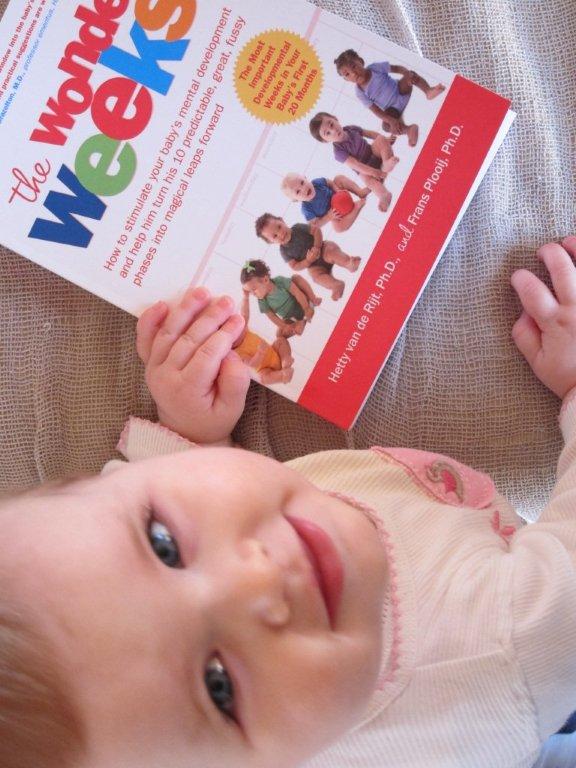
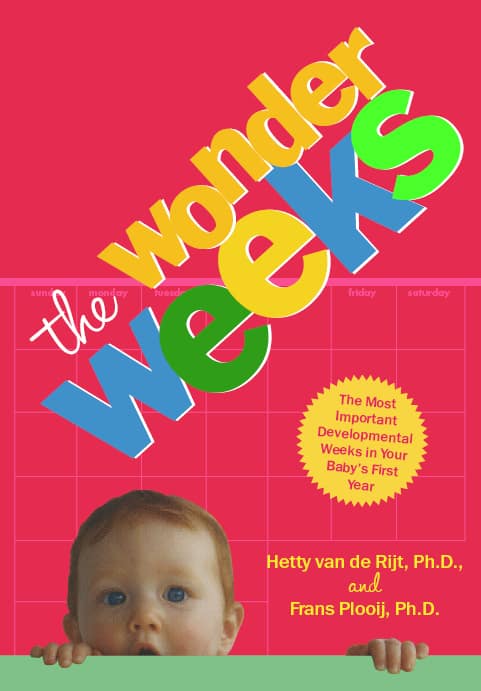
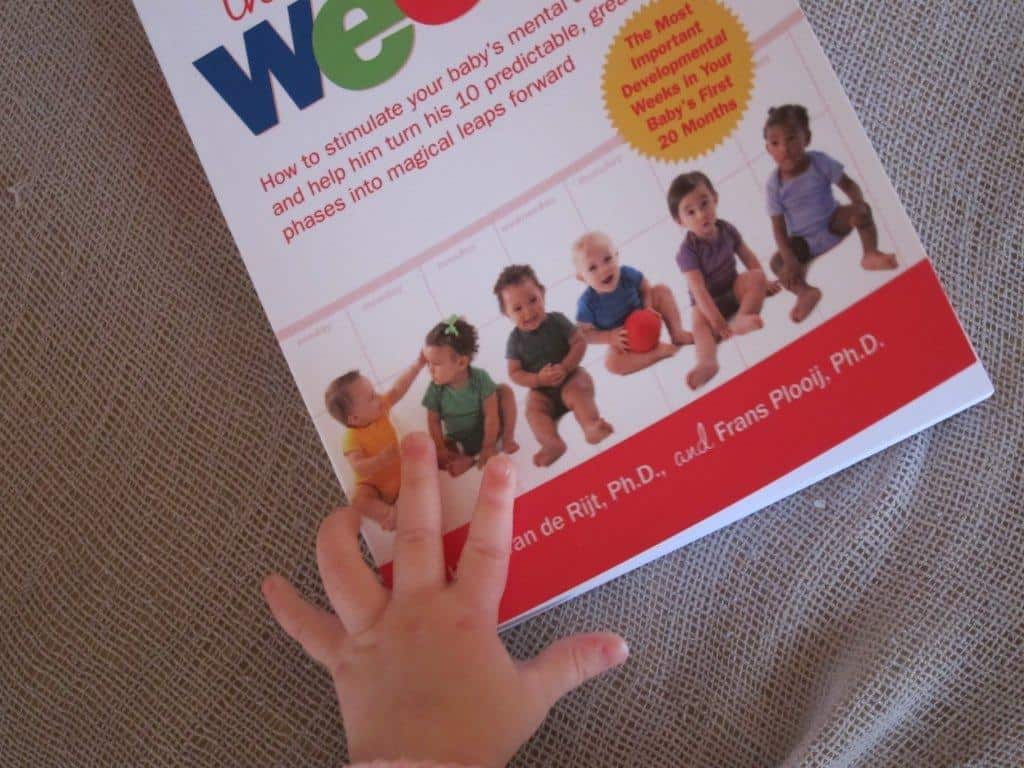
    The Wonder Weeks bookRIGHT now, Baby Holly is in the midst of Wonder Week 46. So you can only imagine how grateful I was to get hold of the updated, fatter version of the worldwide bestseller  The Wonder Weeks book. Yes, the sanity saver book I go on about on this blog, Twitter and Facebook all the time.

    Yesterday I read the sections I hadn’t covered in the original version as my fussy baby displayed the three Cs – cranky, clingy and crying. Oh yes, fun times here. The updated version extends beyond the original eight Wonder Weeks to now feature 10 of these fussy, pull-your-hair-out periods in a baby and toddler’s life.

    What I’ve loved about the book is it’s a real eye opener to why these cranky pants periods can be so frustrating for babies… and parents. They’re kind of like growth spurts, but for the brain. The book sells itself on exactly what it does: helps you to learn how best to stimulate your baby or toddler’s mental development and turn the hair-pulling phases into leaps forward. It never tries to make you believe it’ll turn your baby into a genius. You’ll need Mozart for that.

    The Wonder Weeks book

    I only read the original book each time we were about to embark on another leap to see what the next lot of cognitive growth had in store. So, having now read the entire book, these are the things I loved most about it:

    • It not only explains why things are happening, but also what you can do to help your baby through it. It means you’ll enjoy your baby more and learn how to better cope.
    • It’s broken into the different developmental leaps, making it easy to digest. Each “Week’’ is also broken into smaller categories. Plus, it’s written with the everyday parent in mind. Even this sleep deprived mama found it easy to follow.
    • You’re able to connect with your baby better through the gentle games and activities suggested.
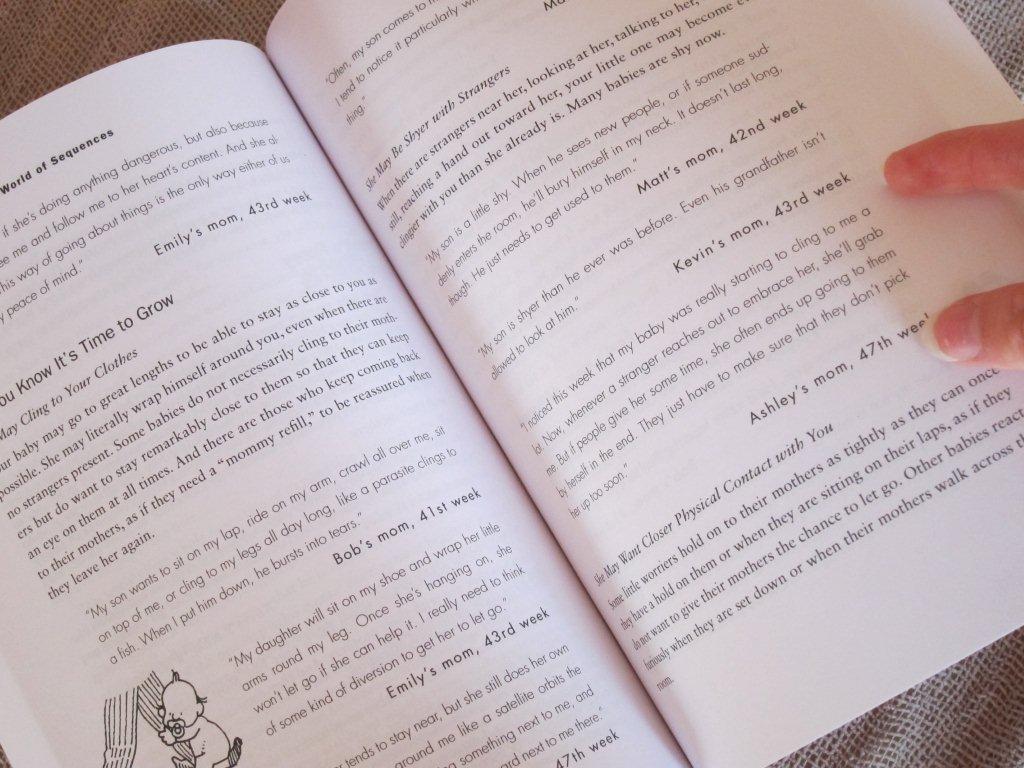
    • It’s packed with quotes and experiences of real parents (and let me tell you, they’re pretty honest), making you feel less alone during the challenging periods. The book is like your parenting support and instils you with greater self confidence.
    • There’s a My Diary section to allow you to record your baby’s progress.
    • The new edition means all those people who wished it was about more than just babies can learn about the developmental leaps right up until 20 months.
    • The book reassures you that every baby is different. So if you baby isn’t doing it “by the book’’ or what another baby of similar age is doing, that’s OK.

    My favourite line from the book is: “we have shown that every baby is `reborn’ 10 times in the first 20 months’’. Lucky we don’t have to go through the labour part as many times.

    The Wonder Weeks

    The book was written by Dutch author Frans Plooij and his wife Hetty van de Rijt, who passed away in 2003. The pair researched parent-baby interactions for 35 years. When Hetty died, the first draft of the last chapter of this revised book was ready.

    While there is an app now available for iPads and iPhones, my only suggestion for the author is for it to be released as an ebook. As a breastfeeding mum, my Kobo eReader is lighter to hold and doesn’t require physical page turning while feeding bub.

    If you want to learn more about the book, you can:

    UPDATE: COMPETITION CLOSED…. To go in the draw to win one of four copies of the new extended version of The Wonder Weeks (ranges in price from $65.95 at Angus and Robertson to $27.62 at The Book Depository) or one of two apps ($1.99 on iTunes), simply tell us three words to describe your baby or toddler right now. The giveaway closes Monday, September 19 at 7pm and a winner will be drawn randomly and announced on this blog and via Facebook and Twitter. Australian residents only. Limit of three entries.

    Want extra entries? Then here’s how you can up your chances in the draw. Each task is worth one extra entry, but must be included as a separate comment (or it won’t count).

    1. Click the Facebook button below and share this giveaway with your Facebook friends. Then leave a separate comment saying something along the lines of “I’ve shared this on Facebook’’.
    2. Click the Twitter button below and share this giveaway with your Twitter followers (Twitter handle is @ThreeLil). Then leave a separate comment saying something along the lines of “I’ve shared this on Twitter’’.
  • Revisiting the book that stopped me crying

    Revisiting the book that stopped me crying

    WONDER Week 37 has come complete with the return of The Diva. The fussy, crying, clingy, sleep-challenged full-on Baby Holly. Yes, move over Diana Ross.

    As explained in my last post, The Wonder Weeks is a book by Hetty Vanderijt and Frans Plooij which has uncovered the eight “fussy’’ phases in the first 14 months of bub’s life and shows you how to turn them into magical leaps forward.

    The problem is I thought the bittersweet Wonder Week 37 had been and gone. Sure, there was the li’l cold and the emergence of the rabbit teeth, but the little bit of cranky during that period was surely the developmental leap. It seems not. On the weekend, we hit week 39 and Baby Holly’s delayed reaction to Wonder Week 37. Kind of like Charlie Sheen’s delayed reaction to now being a nobody. And this Wonder Week’s a doozie. Again, just like Sheen.

    This sixth developmental stage – and by stage I mean mega Opera House-sized stage considering the drama that’s ensued – is called The World of Categories. Baby Holly is:

    • Learning about things belonging together. The example given is “a banana looks, feels, and tastes different than spinach, but they are both foods’’.
    • Her language skills are also continuing to develop, picking up “Ella’’ but still not “mum’’. Hmm. Through her speech development, she’s also beginning to understand a lot more of what I say to her (except for “please, please, say mum just once’’).
    • She’s understanding names and objects, so when I ask her where something is (like Ella), she looks for her.
    • Is mimicking what I do. After patting her on the back the other day when she was coughing, she started patting my shoulder in response. She then laughed when I started coughing.
    • She’s trying to master the art of crawling. She gets up on all fours, does a bit of a rock, tries to get her limbs to move forward and then nosedives. Cue: crying. Thanks to the WW there’s a lot of this happening, especially when it comes to settling of a night.

    Here’s what we’re doing to help her development during Wonder Week 37:

    • Giving her blocks in different sizes to play with
    • Reading her touch and feel books and material books
    • Helping her stack the rings on the pole
    • Playing in and next to her tunnel toy. This helps her learn about space.
    • Sitting in front of the mirror and talking together

    Afterwards, babies are expected to have a greater awareness of their surroundings and can often be more independent.

    I’ve already posted about Week 26, provided a copy of the Wonder Week chart, reviewed the book and had author Frans Plooij guest post. There’s more about the new expanded version of the book on the official Wonder Week site. But to learn more about the Wonder Weeks themselves, buy the book (affiliate link).

    How do you cope with your children’s fussy periods?

  • FEATURE: The book that stopped me crying

    FEATURE: The book that stopped me crying

    Baby Holly

    BABY Holly won’t sleep, is clingy, grizzles no end and fusses over everything. That’s where we’re at right at this moment. However, instead of letting out a *sigh*, a *huff* or showing off a :), I’m jumping for joy. Well, kind of.
    You see, amid Baby Holly’s Naomi Campbell-style hissy fits, I’ve been able to finally get my hands on The Wonder Weeks book. No, this is no Fred Savage tale, although The Wonder Years was a damn fine TV show.
    Written by Hetty Vanderijt and Frans Plooij, The Wonder Weeks has uncovered the eight “fussy’’ phases in the first 14 months of bub’s life and shows you how to turn them into magical leaps forward. Yes, those cranky pants baby episodes are bub simply developing new skills. Cool, huh?
    We’re at the very challenging Wonder Week 26. This one is about relationships, so Baby Holly is beginning to understand that something can be inside, outside, on top, above, next to, underneath or in between something else. Of course, the most important element in all of this is the distance between her and I. When I’m not in the room, all hell breaks loose.
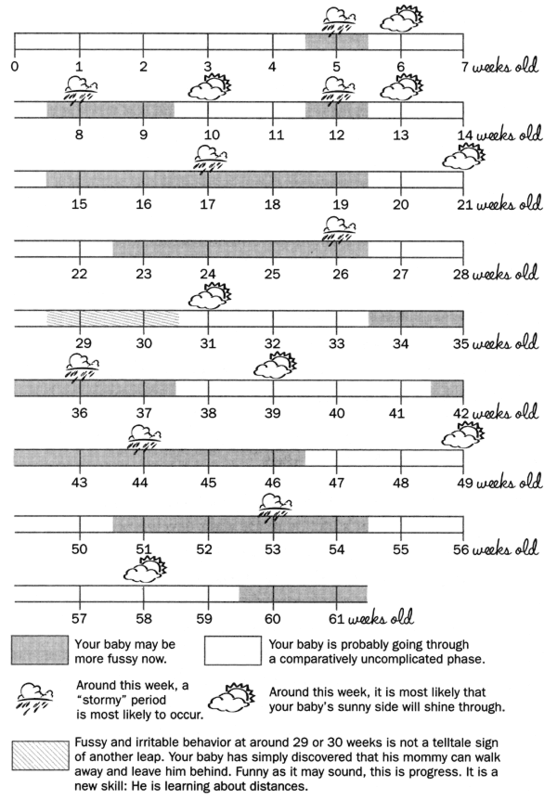
    Here’s one of the most important pages in the book – the one which shows when the Wonder Weeks are (the fussy periods) and the Sunny Weeks (where they’re happy having mastered their new skills and go back to normal). More of those please.

    The book, compiled after studying mums and bubs over a long period of time, shows you which games and toys are best for your baby during each key week and how to encourage each leap forward. Of course, it won’t turn your baby into a genius. Drats!
    Here is a quick guide to each Wonder Week, but really you should check out their website The Wonder Weeks (they even have a leap alarm to sign up to) and grab a copy of the book. I’ve been a bit stingy and borrowed mine from the library, but I may just have to buy a copy (and the more updated version goes through to toddlerdom).
    Wonder Week 5: The World of Changing Sensations
    Wonder Week 8: The World of Patterns
    Wonder Week 12: The World of Smooth Transitions
    Wonder Week 19: The World of Events
    Wonder Week 26: The World of Relationships
    Wonder Week 37: The World of Categories
    Wonder Week 46: The World of Sequences
    Wonder Week 55: The World of Programs
    Now you know when to lock yourself inside the house and ban all visitors. Or put a sign on the door saying: Beware: feral baby inside.
    I’ll give more detailed info on each as Baby Holly experiences them. So first, here’s what we’re doing to help her development during Wonder Week 26:

    • Reading more books, as Holly is now more interested in them
    • Playing with our stacking blocks (building towers and showing how they fit inside each other).
    • Singing and talking to her when I leave the room, so she knows I’m still there.
    • Encouraging her movement (some babies can now start crawling), by giving her plenty of floor time and doing exercises with her arms and legs.

    For more information, I have reviewed the book and had author Frans Plooij guest post. You can also buy the book (affiliate link).

    Have you heard about The Wonder Weeks? How do you cope (or not cope) during your baby’s fussy periods?